What’s My Rep Doing

Last sync: Oct 30, 2026, 2:26 AM UTC

Members

S001150

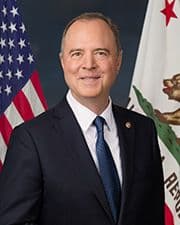
Adam B. Schiff

DemocraticCaliforniaFormer Member
Sponsored
100
Cosponsored
622
Birth Year
1960

Stated Priorities & Legislative Record

Congress 119 · Automated analysis

Reviewed comparisons point both waysAll topics

196 reviewed comparisons · 115 scored · 156 measures

Comparison balance
+1.0/ 2
Supportive
108
Mixed
5
Opposing
2
Unscored
81

Civil Rights

Sponsored
0
Cosponsored
26
Linked House votes
0

What they say Official statements

advocate for equality and human rights at home and around the world

Stated priority

“Adam has also been a leading advocate for equality and human rights at home and around the world.”

About Senator Adam Schiff · Captured 2026-10-28

uphold and strengthen our democracy and the rule of law

Stated priority

“Adam is committed to upholding and strengthening our democracy and the rule of law.”

About Senator Adam Schiff · Captured 2026-10-28

What they do Legislative evidence

S 2589 · Expanding the VOTE Act

Cosponsor

Partly supportsCosponsorship · Reviewed automated analysis

Compared with: advocate for equality and human rights at home and around the world

The cosponsorship meaningfully supports the stated goal of advocating for equality and human rights by backing a bill that expands access to voting materials for people with limited English proficiency and requires translated election materials in covered jurisdictions. That is a concrete civil-rights-related mechanism, though it is narrower than the broad worldwide and domestic human-rights claim and does not by itself address the full scope of the stated priority.

“Adam has also been a leading advocate for equality and human rights at home and around the world.”

Official statement · Captured 2026-10-28

Supporting provisions

“Expanding the Voluntary Opportunities for Translations in Elections Act or the Expanding the VOTE Act This bill expands access to voting materials for individuals with limited proficiency in the English language.”
“Section 203 of the Voting Rights Act of 1965 (VRA) requires covered states and political subdivisions to provide voting materials and other language assistance to persons who are American Indian, Asian American, Alaskan Natives, or of Spanish heritage and whose ability to speak or understand English limits electoral participation.”
“A state or political subdivision that is subject to Section 203 is prohibited from providing English-only voting materials in an election.”
“Among other requirements, this bill (1) requires the Department of Justice to issue a notice of prohibition, including the trigger threshold at which the prohibition applies, to certain states and political subdivisions; and (2) requires covered states and political subdivisions to provide written translations of all voting materials, with the consent of any applicable tribal government, to election workers.”
“Additionally, the bill requires the Election Assistance Commission to make incentive grants for states and political subdivisions to provide translated voting materials.”
Official legislative summary

Summary-based analysis · Action predates captured statement · Narrower scope

Assessed 2026-10-28 · Review: User-authorized automated publication. Published at the user request after the bounded production backfill. Automated evidence validation passed; comparisons have not been individually audited.

Strongly supportsCosponsorship · Reviewed automated analysis

Compared with: uphold and strengthen our democracy and the rule of law

Cosponsoring the Expanding the VOTE Act directly advances the stated goal of strengthening democracy and the rule of law by expanding access to voting materials for limited-English-proficient voters and reinforcing enforcement of Voting Rights Act translation requirements. The bill also mandates DOJ notice, requires translated materials in covered jurisdictions, and provides grants to support implementation, all of which support lawful electoral participation. The bill is narrower than the broad democracy/rule-of-law statement, but it is a direct substantive support for that specific democratic access mechanism.

“Adam is committed to upholding and strengthening our democracy and the rule of law.”

Official statement · Captured 2026-10-28

Supporting provisions

“Expanding the Voluntary Opportunities for Translations in Elections Act or the Expanding the VOTE Act This bill expands access to voting materials for individuals with limited proficiency in the English language.”
“Section 203 of the Voting Rights Act of 1965 (VRA) requires covered states and political subdivisions to provide voting materials and other language assistance to persons who are American Indian, Asian American, Alaskan Natives, or of Spanish heritage and whose ability to speak or understand English limits electoral participation.”
“A state or political subdivision that is subject to Section 203 is prohibited from providing English-only voting materials in an election.”
“Among other requirements, this bill (1) requires the Department of Justice to issue a notice of prohibition, including the trigger threshold at which the prohibition applies, to certain states and political subdivisions; and (2) requires covered states and political subdivisions to provide written translations of all voting materials, with the consent of any applicable tribal government, to election workers.”
“Additionally, the bill requires the Election Assistance Commission to make incentive grants for states and political subdivisions to provide translated voting materials.”
Official legislative summary

Summary-based analysis · Action predates captured statement · Narrower scope

Assessed 2026-10-28 · Review: User-authorized automated publication. Published at the user request after the bounded production backfill. Automated evidence validation passed; comparisons have not been individually audited.

“Section 203 of the Voting Rights Act of 1965 (VRA) requires covered states and political subdivisions to provide voting materials and other language assistance to persons who are American Indian, Asian American, Alaskan Natives, or of Spanish heritage and whose ability to speak or understand English limits electoral participation.”
Official summary source
S 2549 · Time Off to Vote Act

Cosponsor

Partly supportsCosponsorship · Reviewed automated analysis

Compared with: advocate for equality and human rights at home and around the world

Cosponsoring the Time Off to Vote Act meaningfully supports a domestic civil-rights/equality aim by protecting employees' ability to participate in elections without losing pay or benefits. The bill also adds anti-interference and anti-retaliation protections. Its scope is narrower than the broad stated goal of advocating for equality and human rights at home and around the world, and it does not address international human-rights issues, so this is partial rather than direct full support.

“Adam has also been a leading advocate for equality and human rights at home and around the world.”

Official statement · Captured 2026-10-28

Supporting provisions

“Time Off to Vote Act This bill requires an employer, upon the request of an employee, to provide the employee with a minimum of two consecutive hours of paid leave while polls or sites that facilitate voting-related activity are open on the day of a federal election.”
“This allotted time may be used to vote, return a mail-in ballot, or perform other voting-related activities.”
“Taking such leave shall not result in the employee losing accrued employment benefits.”
“The bill makes it unlawful for an employer to interfere with the right to take such leave or for an employer to discriminate against an employee for taking such leave.”
“Further, the bill makes it unlawful for any employer to retaliate against an employee for (1) opposing any practice made unlawful by this bill; (2) filing a charge, or instituting or causing to be instituted any proceeding, under or related to this bill; or (3) testifying or preparing to testify in an inquiry or proceeding relating to such leave.”
Official legislative summary

Summary-based analysis · Action predates captured statement · Narrower scope

Assessed 2026-10-28 · Review: User-authorized automated publication. Published at the user request after the bounded production backfill. Automated evidence validation passed; comparisons have not been individually audited.

Partly supportsCosponsorship · Reviewed automated analysis

Compared with: uphold and strengthen our democracy and the rule of law

Cosponsoring the Time Off to Vote Act meaningfully supports participation in federal elections by requiring paid leave to vote or carry out related voting activities. That is a concrete, if limited, pro-democracy measure. It does not itself broadly reform institutions or the rule of law, so the support is partial rather than a direct comprehensive advancement of the full stated goal.

“Adam is committed to upholding and strengthening our democracy and the rule of law.”

Official statement · Captured 2026-10-28

Supporting provisions

“Time Off to Vote Act This bill requires an employer, upon the request of an employee, to provide the employee with a minimum of two consecutive hours of paid leave while polls or sites that facilitate voting-related activity are open on the day of a federal election.”
“This allotted time may be used to vote, return a mail-in ballot, or perform other voting-related activities.”
“The bill makes it unlawful for an employer to interfere with the right to take such leave or for an employer to discriminate against an employee for taking such leave.”
“Further, the bill makes it unlawful for any employer to retaliate against an employee for (1) opposing any practice made unlawful by this bill; (2) filing a charge, or instituting or causing to be instituted any proceeding, under or related to this bill; or (3) testifying or preparing to testify in an inquiry or proceeding relating to such leave.”
“The bill specifies penalties for employers who violate these provisions.”
Official legislative summary

Summary-based analysis · Action predates captured statement · Narrower scope

Assessed 2026-10-28 · Review: User-authorized automated publication. Published at the user request after the bounded production backfill. Automated evidence validation passed; comparisons have not been individually audited.

“The bill makes it unlawful for an employer to interfere with the right to take such leave or for an employer to discriminate against an employee for taking such leave.”
Official summary source
S 2523 · John R. Lewis Voting Rights Advancement Act of 2025

Cosponsor

Partly supportsCosponsorship · Reviewed automated analysis

Compared with: advocate for equality and human rights at home and around the world

The cosponsorship meaningfully supports a human-rights/equality goal in the specific area of voting rights. The bill expands federal preclearance and notice requirements for jurisdictions with documented voting-rights violations, adds DOJ enforcement tools, and includes protections for election administration. That advances equality in access to voting, though it is narrower than the broad goal of advocating for equality and human rights at home and around the world.

“Adam has also been a leading advocate for equality and human rights at home and around the world.”

Official statement · Captured 2026-10-28

Supporting provisions

“John R. Lewis Voting Rights Advancement Act of 2025 This bill establishes new criteria for determining which states and political subdivisions must obtain preclearance before changes to voting practices may take effect.”
“Preclearance is the process of receiving preapproval from the Department of Justice (DOJ) or the U.S. District Court for the District of Columbia before making legal changes that would affect voting rights.”
“A state and all of its political subdivisions shall be subject to preclearance of voting practice changes for a 10-year period if, during the previous 25 years: 15 or more voting rights violations occurred in the state; or 10 or more violations occurred, at least 1 of which was committed by the state itself.”
“A political subdivision as a separate unit shall also be subject to preclearance for a 10-year period if three or more voting rights violations occurred there during the previous 25 years.”
“States and political subdivisions that meet certain thresholds regarding minority groups must preclear covered practices before implementation, such as redistricting.”
“States and political subdivisions must notify the public of changes to voting practices.”
Official legislative summary

Summary-based analysis · Action predates captured statement · Narrower scope

Assessed 2026-10-28 · Review: User-authorized automated publication. Published at the user request after the bounded production backfill. Automated evidence validation passed; comparisons have not been individually audited.

Strongly supportsCosponsorship · Reviewed automated analysis

Compared with: uphold and strengthen our democracy and the rule of law

The cosponsored bill directly advances the stated goal of upholding and strengthening democracy and the rule of law by adding federal voting-rights enforcement mechanisms. It creates preclearance for jurisdictions with histories of voting-rights violations, requires DOJ or court preapproval for certain voting changes, mandates public notice, and authorizes DOJ information requests to enforce voting protections. These are substantive, direct measures aimed at protecting electoral rules and democratic processes, so the alignment is strong.

“Adam is committed to upholding and strengthening our democracy and the rule of law.”

Official statement · Captured 2026-10-28

Supporting provisions

“John R. Lewis Voting Rights Advancement Act of 2025 This bill establishes new criteria for determining which states and political subdivisions must obtain preclearance before changes to voting practices may take effect.”
“Preclearance is the process of receiving preapproval from the Department of Justice (DOJ) or the U.S. District Court for the District of Columbia before making legal changes that would affect voting rights.”
“A state and all of its political subdivisions shall be subject to preclearance of voting practice changes for a 10-year period if, during the previous 25 years: 15 or more voting rights violations occurred in the state; or 10 or more violations occurred, at least 1 of which was committed by the state itself.”
“A political subdivision as a separate unit shall also be subject to preclearance for a 10-year period if three or more voting rights violations occurred there during the previous 25 years.”
“States and political subdivisions that meet certain thresholds regarding minority groups must preclear covered practices before implementation, such as redistricting.”
“States and political subdivisions must notify the public of changes to voting practices.”
Official legislative summary

Summary-based analysis · Action predates captured statement · Narrower scope

Assessed 2026-10-28 · Review: User-authorized automated publication. Published at the user request after the bounded production backfill. Automated evidence validation passed; comparisons have not been individually audited.

“John R. Lewis Voting Rights Advancement Act of 2025 This bill establishes new criteria for determining which states and political subdivisions must obtain preclearance before changes to voting practices may take effect.”
Official summary source
S 2476 · Disability and Age in Jury Service Nondiscrimination Act

Cosponsor

Strongly supportsCosponsorship · Reviewed automated analysis

Compared with: advocate for equality and human rights at home and around the world

Cosponsoring this bill is a direct substantive advance of the stated goal of advocating for equality and human rights, at least in the domestic context. The bill forbids exclusion from jury service based on disability or age and requires reasonable accommodations for disability-related qualification issues, which clearly promotes equal civic participation. The action is narrower than the broad global framing of the priority, but it still meaningfully supports the equality/human-rights component.

“Adam has also been a leading advocate for equality and human rights at home and around the world.”

Official statement · Captured 2026-10-28

Supporting provisions

“Disability and Age in Jury Service Nondiscrimination Act This bill prohibits the exclusion of individuals from jury service on the basis of their disability or age.”
“Further, the bill prohibits the disqualification of individuals from jury service who fail to meet certain qualifications (e.g., adequate proficiency in English) on the basis of their disability if reasonable accommodations can be made.”
Official legislative summary

Summary-based analysis · Action predates captured statement · Narrower scope

Assessed 2026-10-28 · Review: User-authorized automated publication. Published at the user request after the bounded production backfill. Automated evidence validation passed; comparisons have not been individually audited.

Partly supportsCosponsorship · Reviewed automated analysis

Compared with: uphold and strengthen our democracy and the rule of law

Cosponsoring this bill meaningfully supports the rule of law component of the stated goal by expanding fair access to jury service and limiting exclusion or disqualification based on disability or age. Jury service is a core legal institution, and the bill's nondiscrimination rules strengthen equal participation in that institution. The connection is supportive but narrower than the broad goal of 'upholding and strengthening our democracy and the rule of law,' so this is best scored as partial support rather than direct full support.

“Adam is committed to upholding and strengthening our democracy and the rule of law.”

Official statement · Captured 2026-10-28

Supporting provisions

“Disability and Age in Jury Service Nondiscrimination Act This bill prohibits the exclusion of individuals from jury service on the basis of their disability or age.”
“Further, the bill prohibits the disqualification of individuals from jury service who fail to meet certain qualifications (e.g., adequate proficiency in English) on the basis of their disability if reasonable accommodations can be made.”
Official legislative summary

Summary-based analysis · Action predates captured statement · Narrower scope

Assessed 2026-10-28 · Review: User-authorized automated publication. Published at the user request after the bounded production backfill. Automated evidence validation passed; comparisons have not been individually audited.

“Disability and Age in Jury Service Nondiscrimination Act This bill prohibits the exclusion of individuals from jury service on the basis of their disability or age.”
Official summary source
SRES 312 · A resolution recognizing June 2025, as "LGBTQ Pride Month".

Cosponsor

Strongly supportsCosponsorship · Reviewed automated analysis

Compared with: advocate for equality and human rights at home and around the world

Cosponsoring a resolution that expressly supports the rights, freedoms, and equal treatment of LGBTQ people, and states that LGBTQ rights are human rights, is a direct substantive endorsement of equality and human rights. The action is narrower than the broad global claim, but it clearly advances the stated policy goal in the context of LGBTQ rights at home and internationally referenced by the resolution.

“Adam has also been a leading advocate for equality and human rights at home and around the world.”

Official statement · Captured 2026-10-28

Supporting provisions

“This resolution expresses support for the rights, freedoms, and equal treatment of lesbian, gay, bisexual, transgender, and queer (LGBTQ) individuals.”
“The resolution recognizes that LGBTQ rights are human rights and protected by the laws of the United States and international treaties.”
Official legislative summary

Summary-based analysis · Action predates captured statement · Narrower scope

Assessed 2026-10-28 · Review: User-authorized automated publication. Published at the user request after the bounded production backfill. Automated evidence validation passed; comparisons have not been individually audited.

No direct connectionCosponsorship · Reviewed automated analysis

Compared with: uphold and strengthen our democracy and the rule of law

The stated priority is to uphold and strengthen democracy and the rule of law. The cosponsored resolution is about recognizing LGBTQ Pride Month and expressing support for LGBTQ rights. That is a rights-recognition measure, but the supplied passages do not show any direct mechanism affecting democratic institutions, constitutional governance, courts, elections, or rule-of-law administration. So a defensible comparison cannot be made from the provided text.

“Adam is committed to upholding and strengthening our democracy and the rule of law.”

Official statement · Captured 2026-10-28

Supporting provisions

“This resolution expresses support for the rights, freedoms, and equal treatment of lesbian, gay, bisexual, transgender, and queer (LGBTQ) individuals.”
“The resolution recognizes that LGBTQ rights are human rights and protected by the laws of the United States and international treaties.”
Official legislative summary

Summary-based analysis · Action predates captured statement

Assessed 2026-10-28 · Review: User-authorized automated publication. Published at the user request after the bounded production backfill. Automated evidence validation passed; comparisons have not been individually audited.

“This resolution expresses support for the rights, freedoms, and equal treatment of lesbian, gay, bisexual, transgender, and queer (LGBTQ) individuals.”
Official summary source

Prepared Legislative Analysis

119th Congress · computed from the latest committed analytics snapshot

Updated Oct 29, 2026, 11:00 AM

Sponsored
100
Cosponsored
622
Progressed
155
Floor or later
88
Final success
67
Bill actions
2,405

Top Policy Areas

International Affairs

79

Health

78

Government Operations and Politics

69

Agriculture and Food

57

Crime and Law Enforcement

54

Armed Forces and National Security

42

Taxation

30

Public Lands and Natural Resources

29

Monthly Bill Activity

Jan 2025
57
Feb 2025
121
Mar 2025
95
Apr 2025
111
May 2025
125
Jun 2025
90
Jul 2025
135
Aug 2025
8
Sep 2025
135
Oct 2025
65
Nov 2025
95
Dec 2025
137
Jan 2026
75
Feb 2026
95
Mar 2026
169
Apr 2026
166
May 2026
72
Jun 2026
205
Jul 2026
154
Aug 2026
97
Sep 2026
190
Oct 2026
8

Terms

119th

Senate

Senator · California

2024
118th

House of Representatives

Representative · California · District 28

2001 - 2024
118th

Senate

Senator · California

2024 - 2025
117th

House of Representatives

Representative · California · District 28

2001 - 2024
116th

House of Representatives

Representative · California · District 28

2001 - 2024
115th

House of Representatives

Representative · California · District 28

2001 - 2024
114th

House of Representatives

Representative · California · District 28

2001 - 2024
113th

House of Representatives

Representative · California · District 28

2001 - 2024
112th

House of Representatives

Representative · California · District 29

2001 - 2024
111th

House of Representatives

Representative · California · District 29

2001 - 2024
110th

House of Representatives

Representative · California · District 29

2001 - 2024
109th

House of Representatives

Representative · California · District 29

2001 - 2024
108th

House of Representatives

Representative · California · District 29

2001 - 2024
107th

House of Representatives

Representative · California · District 27

2001 - 2024

Committee Assignments

Committee on Agriculture, Nutrition, and Forestry

Member · Senate.gov

0 bills · 25 reports · 428 nominations · 8,928 communications

Committee on Environment and Public Works

Member · Senate.gov

0 bills · 437 reports · 620 nominations · 10,126 communications

Committee on Small Business and Entrepreneurship

Member · Senate.gov

0 bills · 101 reports · 60 nominations · 662 communications

Committee on the Judiciary

Member · Senate.gov

0 bills · 180 reports · 5,536 nominations · 2,179 communications